Friday, October 21, 2011

Tropical Space Age Architecture- Part 2


“On October 4, 1957, a finger reached out and pushed a button in the Soviet Union, launching Sputnik, the first man-made satellite, into orbit. Afraid of losing face during the Cold War, a stunned United States responded in several ways, one of the most unusual of which was the building of the 1962 Seattle World’s Fair.”

“The original theme of the fair was ‘Festival of the West’, celebrating the past. But with Sputnik circling overhead, the focus now became the future and the space race was on. The fair took on a decidedly science and space focus, as reflected in its formal name, the Century 21 Exposition. The fair is best known, though, as the less elegant sounding 1962 Seattle World’s Fair.”

As a result, the theme of the architecture of the fair had some of the best examples of space-age googie design ever built in the United States.


This simple pen sketch is a masterpiece of Tropical Space Age design for the fair’s Islands of Hawaii Pavilion with the Space Needle in the background.


Color rendering


Construction begins on the Islands of Hawaii Pavilion


The Space Needle and palm trees, what a beautiful clash of primitive and modern cultures.


Construction is complete and the Fair opens on April 21, 1962. This is an easy to find postcard of the Hawaii pavilion that was sold at the fair. Upon closer inspection, you can see the tiki torches are burning and there are three large fern wood tiki statues (two on the left in the sandy landscaped area and one near the food service window).


This is a rarer shot of the building showing the googie designed signage up top.


If you wanted to do some shopping at the fair, all you had to do was head over to the Boulevard of the World and you could find items from around the globe.


Note the two red painted tikis standing guard at the entrance into one of the stores.


At the end of the Boulevard of the World was the Philippines Pavilion with its giant tiki face and mouth doorway.


Here you could pick up a tiki or a moai carving. Note the world’s largest tiki fork and spoon set hanging on the outside wall. Those are awesome! How many of you tiki collectors out there have the smaller version of the fork and spoon set, I bet you all do. I’ve got a set hanging in my tiki bar.


If you still need to finish your shopping, head back over to the Hawaii pavilion and pick up a World’s Fair aloha shirt. What a great aloha fabric design. I like the comparison of the Space Needle to the Aloha Tower and the Hawaiian pavilion with Diamond Head in the background.


After all of that shopping, how about heading over to the Gayway for a Space Needle ice cream cone.


I love those Space Needle cones with a wafer platform on top!


If you want to step back in time to see what it was like to visit the fair in 1962, check out this video produced by the Bell Telephone company called ‘Century 21 Calling’. It starts on the Alweg monorail then travels around the fair. The sound track really sets the mood and takes you back. The first 4:30 minutes and the last 1:30 are great, the middle of the video is a sales pitch for Bell telephones (it’s fun to see what passed for new technology back then).


When the City built the 1962 World’s Fair, a monorail was included. One station was located at the fair, near the Space Needle. The other station was located in downtown Seattle. It was a short 1.2 mile ride down 5th Avenue to the Westlake station at the other end.

The intent after the fair closed on October 21, 1962, was to expand the monorail system to serve other portions of Seattle. Sadly, that never happened. However, the monorail is still in existence and running today. In fact, I was just in Seattle a few weeks ago and took a ride on the monorail and the Space Needle while I was in town.

Now what’s interesting to tikiphiles when it comes to the monorail, is the fact that it travels along 5th Avenue and the end station is only a block away from the current Westin Hotel. Back in the day, the Westin used to be the Hotel Benjamin Franklin. Tikiphiles may recognize that name, because the Benjamin Franklin was home to Seattle’s Trader Vic’s restaurant. Originally, Trader Vic’s opened as The Outrigger in 1948. The name was later changed to Trader Vic’s.


The World’s Fair monorail and Trader Vic’s at the Hotel Benjamin Franklin. The Space Needle is visible in the background between the monorail and the Trader Vic's sign.

The Seattle Trader Vic’s had the very unique distinction of being the only Vic’s that was accessible via monorail! It was only a one block walk from the Westlake Station.


Seattle Trader Vic’s at the Hotel Benjamin Franklin.

This entrance faced 5th Avenue. If the photographer would have rotated to face down the street, the monorail would have been visible overhead along the center of 5th Avenue. That would have been a cool photo (I’ve been looking for a long time and have never found a photo like that).


Interior of the Seattle Trader Vic’s

The Hotel Benjamin Franklin was converted to the current Westin in 1967 and Trader Vic’s continued to operate there until it closed in 1991.

Imagine what a great day it would have been to spend at the 1962 World’s Fair, then hop on the monorail over to Trader Vic’s in the early evening for an exotic cocktail and a pupu platter.


Your evening didn’t have the end there. After cocktails at Trader Vic’s you could have headed over to Pier 51 a few blocks away to have an elegant dinner at the Polynesia Restaurant.


The Polynesia Restaurant, while not Tropical Space Age design on the exterior, was very different from Trader Vic’s and most other tiki restaurants. The interior was sleek and modern. Check out that awesome sculpture on the right. It is a tube that spirals up towards the ceiling. Little holes are poked in the tube and ignited so that flames extend around the piece.

The only tiki visible in this picture is the small 3’ stature in front of the hostess stand. Does it look familiar? Go back up in this post to the color photo of the Philippine pavilion and check out the two tikis standing guard at the top of the steps. They are the same. Looks like the folks at the Polynesia bought their tiki at the fair and brought him home to their restaurant.


1962 would have been a great year to be in downtown Seattle. The Century 21 Exposition, Trader Vic’s and the Polynesia were all within a mile or two of each other and each represented a different type of Polynesian Pop design, including Tropical Space Age, Tiki and Tiki Modern respectively.


One last resource if you’re looking for some more great visuals from the fair. Put the Elvis movie “It Happened at the World’s Fair” into your Netflix queue. It was filmed on location at the fair and is an hour and half of Elvis and World’s Fair goodness. It’s a fun movie.


Credit: Some of the text and photos are from ‘Seattle’s 1962 World’s Fair’ by Bill Cotter.

Sunday, October 16, 2011

Tropical Space Age Architecture- Part 1


Cover Art, Amazing Stories, 1963


Tropical Space Age Architecture is a term coined by Desoto Brown of the Bishop Museum in Honolulu, Hawaii. He describes the architectural style as "A comtemporary Island Idiom merging the Jet Age with the Tropics."


Desoto Brown

It was a mid-century design style that was popular in Hawaii, however, local architects and islanders did not particulary appreciate the outlandish look. As of today, most of these buildings are long gone. However, if you dig around long enough, you can also find many fine examples of Tropical Space Age buildings that were built here on the mainland.


The Space Age future as envisoined on Saturday morning cartoons in 1962.


Upon closer inspection, that space age design looks vaguely familar......


....Ah yes, That's it. The Hyperbolic Parabolid shaped lobby of the Waikikian Hotel in Honolulu (demolished 1997), a stunning example of Tropical Space Age.


That's a neato design......have I seen that as a tiki restaurant before?.....


...Not exactly the same, but another gleaming example of Tropical Space Age. This was the Hilton Inn in St. Petersburg, Florida. The hotel hosted three different Polynesian Restaurants, including the beachside Aekai restaurant, the Luau Room (on the 10th floor, accessed via the exterior glass elevator on the front of the building), and the rotating Bali Hai Lounge on the top of the building (what an excellent place to sip an exotic cocktail while waiting for your resversation down in the Luau Room.) Note the beautiful upswept Port Cochere over the front door.


...A few of the stand alone Don the Beachcomber restaurants echoed this UFO inspired design, including...


Don the Beachcomber, Marina Del Rey, California


Don the Beachcomber, Dallas, Texas.

The Dallas location had the overall round UFO shape, but added additional exterior elements like the upswept decorative beams over the entrance, the waterfall and bridge over the lagoon, and flaming tiki torches in the lagoon and on the roof of the building.


In 2001, photographer Tony Paiva created this Photoshop art titled 'Trad'r Rix Tiki Island' which is a literal interpretation of Tropical Space Age style.


Thursday, October 13, 2011

Buildings of Hawaii - Book Review


A few months ago I received a special package in the mail from the Society of Architectural Historians. One of the staff members of SAH had read my blog post on the Evolution of the Hawaiian Style Roof and then sent me a copy of a book they had just published called Buildings of Hawaii.


Don J. Hibbard, 2011
334 pgs., 250 illustrations


The Society of Architectural Historians has a long range plan to publish a series of Buildings of the United States (BUS) books documenting the rich diversity of architecture of each state. They currently have five volumes, including:

Buildings of Delware (2008)
Buildings of Massachusetts: Metropolitan Boston (2009)
Buildings of Pennsylvania: Philadelphia & Eastern Pennsylvania(2010)
Buildings of Pennsylvania: Pittsburg & Western Pennsylvania (2010)
Buildings of Hawaii (2011)

I just finished reading the book and now know more than I will ever need to know about architecture on the six major islands in the Hawaiian chain.

The book contains 500 entries and is filled with facts, details and dates for every significant building in Hawaii. It includes a study of masterworks by Hawaiian based architects such as Vladimir Ossipoff, George 'Pete' Wimberely, and C.W. Dickey (along with an essay about Dickey 'Hawaiian Style' Roof) as well as many mainland architects.

It also includes a short section on Waikiki and the mid-century designs that sprung up there in the form of hotels and apartments.

Buildings of Hawaii is a great reference volume and is available on Amazon or the Society of Architectural Historians website.

Sunday, August 14, 2011

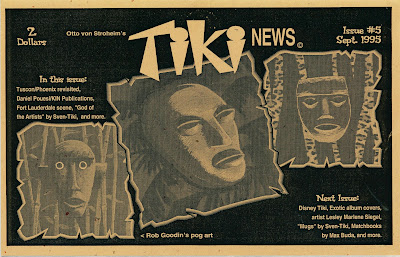
Tiki News - Issue #5

Aloha, Amigos!

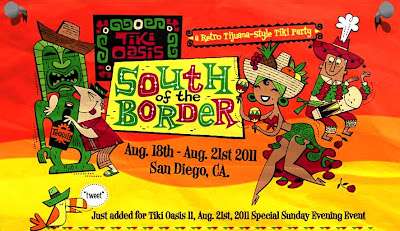
I'm back after a short summer hiatius of posting to the blog. This is a great week to start things back up again as the grandaddy of all tiki events, Tiki Oasis, rolls back into San Diego.


11th Annual Tiki Oasis


I remember attending the first Tiki Oasis event when it was held in Palm Springs (it was in August that year HOT HOT HOT!!). It's amazing to see how this event has changed over the last decade from a small group of folks that first year to over two thousand last year. Mr. Otto Von Stroheim is the man responsible for creating and sustaining Tiki Oasis. However, in the mid 1990s pre Tiki Oasis, Otto was also helping to revitilize the Polynesian Pop movement with his 'zine publication Tiki News.


Issue #5 September 1995


Stories in Issue #5 included:

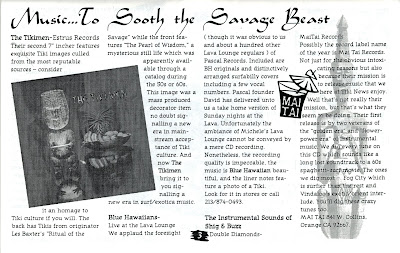
Music to Sooth the Savage Beast - A review of new exotic and surf releases.


An American Samoan in Carson - A book review of The Stone Maiden and other Samon Fables (author Daniel Pouesi)


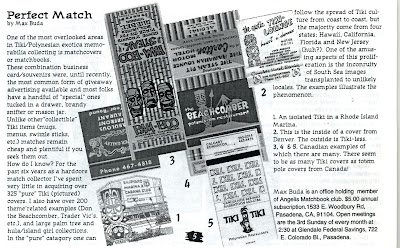
Perfect Match - A story by Max Budda on collecting tiki matchbook covers.


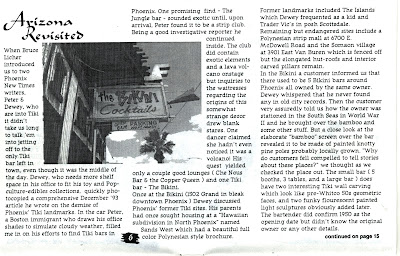
Arizona Revisited - A trip report to investigate tiki in Phoenix.


Eddy Detroit of Phoenix - A story about this exotic DJ and musician.


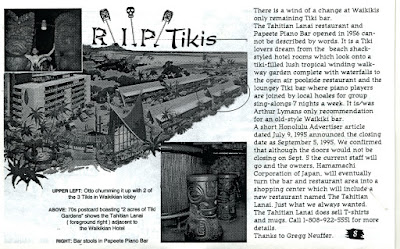
R.I.P. Tikis - A story about the closing of the Tahitian Lanai at the Waikikian Hotel in Honolulu.


Tiki Pogs - Do you remember the Pog craze of the mid 1990s? A Pog was a printed image on thick circular cardboard simultaing old milk bottle caps. A short article showcasing Pogs with with exotic and tiki images.


Tiki God of the Artist, Anecdotes from the Birth of Modern Art - A two page story written by Sven Kristen about tiki imagery in art works, including Picasso.


Neighborhood Tiki - Readers could send in photos of tikis found in their local neighborhood.


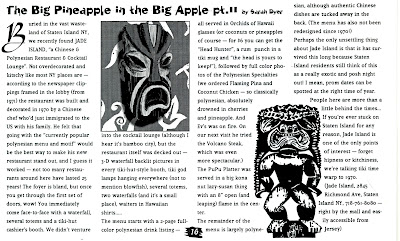
The Big Pineapple in the Big Apple, Part II - A continuation of a trip report written by Sarah Dyer on exploring tiki in New York City.


Part I of this NYC trip report was presented back in Issue #4.


Mad About the Mai Kai - A trip report to Ft. Lauderdale, Florida, written by Becky Ebenkamp.


Tune into Tiki - A listing of upcoming radio shows.


Thursday, June 16, 2011

Mai Kai themed housing - Boca Raton, Florida


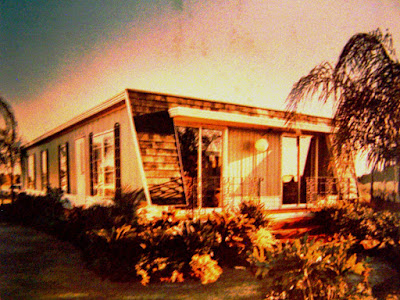
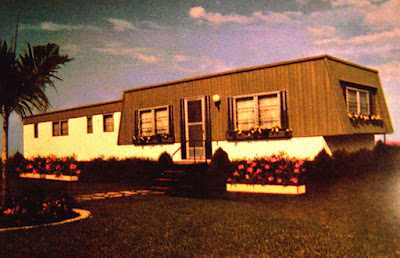
If you have ever visited the Mai Kai down in Ft. Lauderdale, Florida and thought to yourself “I want to live in this tropical tiki temple!”, you could have had the chance.

In 1969 a residential development called Sandlefoot Cove hosted its Grand Opening, located just 17 miles north of the Mai Kai restaurant, near the City of Boca Raton. Here is a story that ran in the Fort Lauderdale News on September 27, 1969.


The adventure and glamour of Ft. Lauderdale’s celebrated Mai Kai restaurant has come to the new mobile home community of Sandlefoot Cove. But it comes in a wholly unexpected and surprising way, in the form of a new 24 by 57 foot mobile home named Mai Kai. The first mobile home ever designed to capture sub tropical living. The Princess Homes, Inc. model represents a blending of all the light and openness associated with Florida life, plus the allure of faraway Polynesia.”


Sandlefoot Cove will include two championship golf courses. The Mai Kai home design, represented at Sandlefoot Cove by Brownstone Trailer Sales, features a floor plan consisting of two bedrooms, two baths, living room, kitchen and a ‘lanai’ dining area. Design of the home and it’s decorations borrow heavily from the charm of Polynesia – rain cape thatch, basket weave matting, shag carpet, bamboo moldings, sculptured shell basins and rattan furniture.”


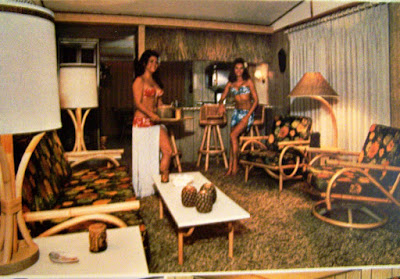
Living Room of the Mai Kai features a Polynesian atmosphere, as modeled by two the of the Mai Kai Maidens


A bamboo matted headboard, drapes reminiscent of Tahiti and a Tonga pictorial pattern in the adjacent bath set the theme in the master bedroom. A second bedroom also pictures a South Pacific setting of ease.

A Hawaiian mural extends from tub to ceiling in the center bath. Against a Samoan flower wall, a specially sculptured shell basin adds a further Polynesian flavor.”

In the living room, rattan furniture melds into a grass matted feature wall and light driftwood paneling.

Builder of the new Mai Kai residence is Princess Homes Inc.., of Pompano Beach, a subsidiary of Zimmer Homes Corp., which has been in the housing industry for over 35 years.”


Color photos were taken from the Z Annual Report, located in the Mai Kai archives

Tuesday, June 7, 2011

Going to Hukilau!


Aloha Friends! I'm heading to the airport to spend the next 5 days in the Florida sunshine enjoying The Hukilau and the Mai Kai. I'll be back next week.

Sunday, June 5, 2011

Trader Sam's, Disney's new tiki bar now open


Back in June 2010, I posted a six part series about the new tiki project at the Disneyland Hotel in Anaheim, California. A few weeks ago the restaurant (Tangaroa Terrace) and bar (Trader Sam's) opened to the public. The new bar is getting great reviews (read them here , here, and here) and I look forward to visiting next time I'm in Southern California.

The building that houses the Tangaroa Terrace was built in 1970 as part of the new Marina expansion at the hotel and has seen a lot of changes over the last 40+ years, let's take a look.


A 1968 rendering for the new Marina and Marina Tower, including the Shipyard Inn Restaurant (pictured in the middle, later to become Hook's Pointe and then Tangaroa Terrace)


The new Marina and Shipyard Inn


Shipyard Inn on the Marina

In 1979, major changes happend around the Marina and Seaports of the Pacific was opened. The new area included more restaurants and an International Shopping Bazaar filled with imports from Hong Kong, Australia, Mexico and Tahiti.


Seaports of the Pacific, 1982


As part of the opening of the new Seaports of the Pacific, the Disneyland Hotel also opened Water Wonderland which included Horseshoe Falls, the Dancing Waters fountain show, Papeete Beach and a Polynesian themed musical revue called Pacific Terrific!


The free nightly Polynesian revue began with lighting the torches around the Marina


Then the show would begin and an outrigger canoe was paddled out into the middle of the Marina with guests along the rails to watch the show.


You can see the canoe moving into position in the center of the port

On board the outrigger, several Hawaiian dancers would perform a show for the guests.


I vividly remember standing along the rail as a kid watching this show and the fire dancer doing his thing out in the canoe


Another shot of the outrigger canoe in the Marina


For those who didn't know, the Disneyland Hotel had Polynesian themeing 30+ years before Tangaroa Terrace opened!


Fast forward to 2010 and Walt Disney Imagineering prepares to transform the old Shipyard Inn/Hook's Pointe into the Tangaroa Terrace.


The roofline is inspired by the Great Ceremonial House at the Polynesian Village at Walt Disney World in Orlando, Florida.


Great Ceremonial House at WDW


In the late 1990's the Marina was drained and filled in and the area was rethemed to Peter Pan, including changing the Shipyard Inn into Hook's Ponite.


Tangaroa Terrace Before & After

Click to enlarge


Trader Sam's Before & After

Click to enlarge


WDI concept art for the interior of Trader Sam's


Completed interior of Trader Sam's. I love the details including the tiki poles from the Enchanted Tiki Room and the crate hanging from the ceiling with the arrow shot into it.


For your listening pleasure, A fan inspired soundtrack for Trader Sam's (created by graphic designer Richard Terpstra).


SIDE NOTE OF INTEREST: Richard has also just created this great T-shirt inspired by the Dole Whip treat found at the Enchanted Tiki Room.


You can purchase the Tiki Pineapple Whip Tee here.


Various image credits for today's post: The Magical Hotel and Meet the World